Larkin farm
The Darling Buds of MayLarkin farm is the Larkin family’s home, workplace, and self-fashioned alternative to the orderly institutions beyond it. A place of orchards and seasonal fields as well as rusty iron, animals, and crowded rooms, it sustains a household that treats abundance as a way of life and official rules as another opportunity for improvisation. Its apparent plenty, however, depends on an agricultural calendar that can be disrupted by disease and declining crops.
Setting and First Impressions
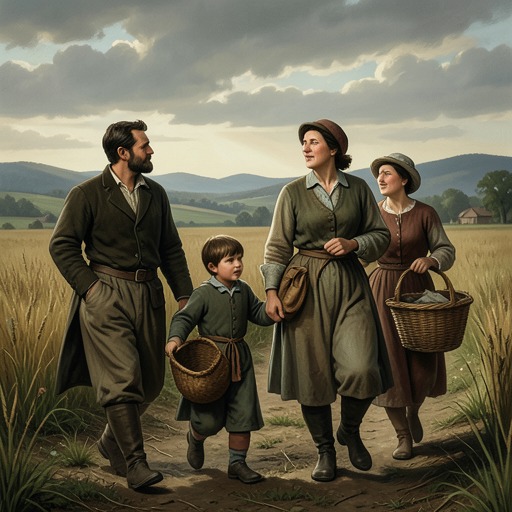
The farm first appears in the surrounding countryside, approached past orchards whose branches lift pink in the sunlight and strawberry fields covered with fresh yellow straw. The fields are not incidental scenery: they announce the work ahead. Pop slows the truck beside the rows and invites the children to join the picking, while the family’s attention is already moving with the season. A glimpse of the landscape thus introduces the practical rhythm that underpins life at home.
At the end of the drive, the house suddenly appears beyond a scrubby fringe of woodland, part bluebells and part scratching red-brown hens. Pop looks at it with pride; its appeal lies less in conventional neatness than in the familiar, living world gathered around it. The truck then stops in a dusty yard crowded with nettles, old oil drums, corrugated pigsties, and piles of rusty iron. White ducks, three grey goats, and another batch of red-brown hens answer the arrival with a flurry of heads and wings. The scene joins domestic welcome to unruliness: the farm is a home whose bustle cannot be separated from its animals, work, and accumulated clutter.
A Home Organized by Plenty
The farm’s welcome is expressed through food as readily as through its view. When Cedric Charlton visits, the kitchen radio plays jazz while a television flickers in the next room, where nine faces are crowded around a table. Pop urges the visitor to take whatever he wants. Pineapples stand amid fish and chips, ice-cream, jam, ketchup, Guinness, Worcester sauce, tea, chocolate biscuits, and iced buns. The hospitality is lavish and haphazard, an extension of the household’s confidence that there is always room for one more person and something more to put on the table.
That welcome is also physical and social rather than merely material. The farm’s cluttered yard and animals provide the setting for Charlton’s bewildering adjustment to a household he had not expected to inhabit. Outside, he takes in what he understands as Pop’s paradise: junk, hens, geese, rusty iron, and Montgomery milking goats under a haystack. Beyond this unlikely arrangement, white moon-daisies have spread along the meadows, and a cuckoo calls from the oak trees. The view sets the rough, improvised farm against a calm summer landscape without making either disappear. The place can look disorderly to an outsider and still offer a powerful sense of belonging and renewal.
Work, Seasons, and Economic Vulnerability
Agricultural time gives the farm’s surroundings a working calendar. June brings strawberries and then, before the month ends, cherries; cherries continue through July. In good summers, apples may begin before August, alongside early plums and pears. Apples return in August and September, while September brings hops and October potatoes. Pop’s estimate that a large family could earn fifteen pounds a day from strawberries makes the fields’ beauty legible as a source of income. The view of the rows and the expectation of work are two aspects of the same landscape.
The practical rhythm appears in conversations at home as well. Montgomery reports that strawberry picking at Benacre will begin on Monday, earlier than ever, and Pop attributes the early crop to the weather. The news turns seasonal change into an immediate household concern: the harvest is arriving, so the family’s labor and earnings are about to be tested in the fields. When Charlton works in the picking operation, he checks in more than a ton of strawberries in a day and begins thinking about the tax implications of the sum earned. The farm’s productive scale draws the visitor into its everyday economy even as it exposes the contrast between his professional habits and Pop’s outlook.
That abundance is precarious. Pop says that disease has finished varieties including Sovereigns, Climax, and Huxleys, and predicts that strawberries will soon disappear everywhere; in two years, he says, the strawberry business will be over. His forecast transforms the farm’s seasonal landscape from a dependable source of work into an uncertain future. The fields that had seemed to guarantee a family livelihood are vulnerable to crop disease and the decline of the fruit-picking trade. Larkin farm’s prosperity is therefore energetic but not secure: it rests on weather, harvests, and crops that can fail.
The Farm and the Outside World
The farm’s distance from ordinary routines is real but not absolute. Charlton tries to leave, only to learn that the eight o’clock bus no longer runs; it was discontinued after petrol rationing began and never restored. That missing service turns the farm’s remoteness into a concrete constraint on a visitor’s plans. The household’s own busy life carries on in a different register, with meals, conversation, television, animals, and work filling the space that the vanished bus has left between the farm and elsewhere.
Official systems nevertheless reach the farm. A young man arrives with a briefcase and tells Pop that records show no income return for the previous year. Pop claims that nobody asked him to file, and the visitor produces the yellow-buff form he says should have been sent. The encounter places tax administration directly against the farm’s self-sufficiency: the family’s work and earnings may be rooted in the fields, but the state claims a view of them through forms and records. Later, Pop calls the National Health service another government-created scheme that Charlton ought to use, urging him to take sick leave rather than be a fool about benefits he has paid for. These exchanges show the farm as a place where institutional rules are discussed, disputed, and turned to practical use, not a world sealed off from them.
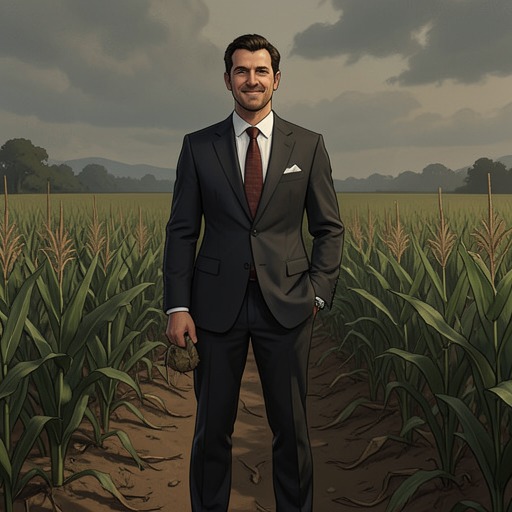
That resistance has a long-term consequence for the family’s business. After marrying Mariette, Charlton leaves his job in the tax inspector’s office for other work, a change that pleases Pop because he dislikes having anyone in the family connected with the tax service. Pop gives Mariette and Charlton five hundred laying pullets, establishing them in egg production. In less than a year, they make enough profit to buy another five hundred. Charlton still files proper income-tax returns on the enterprise, a habit Pop considers unwise. The episode extends the farm’s pattern of turning animals and practical opportunities into income, while showing that even within the family Pop and Charlton do not share the same attitude to official obligations.
Narrative Significance
Larkin farm brings together the book’s central contrasts: cultivation and scrap, seasonal work and abundant meals, natural beauty and economic risk, family independence and the reach of government. Its disorder is not simply a picturesque backdrop. The animals and clutter shape the visitor’s experience; the fields determine the household’s labor; and the farm’s profits generate disputes about taxes, sick leave, and paperwork. The place makes Pop’s expansive idea of home tangible, but the threatened strawberry crop also makes clear that his confidence cannot control every force on which the family depends.
The farm’s recurrent scenes of arrival and welcome also give it a social function. Visitors encounter crowded tables, a lively yard, and a household ready to absorb them into its routines. Yet the same setting can trap someone trying to leave, as Charlton discovers when there is no bus, or unsettle someone unused to its animals and customs. Larkin farm is therefore both refuge and exposure: it draws people into the family’s orbit while bringing them face to face with a way of life governed by work, appetite, weather, and Pop’s irrepressible improvisation.